00/business automation
AI Use Cases for Business Automation: A Guide for UAE Enterprises in 2026
AI USE CASES
01/quick answer
The strongest AI use cases for business automation in the UAE are repeated workflows with clear inputs, outputs, and escalation rules: lead qualification, document intake, appointment booking, CRM updates, invoice follow-up, reporting, and internal knowledge support. Start with one measurable process before expanding into wider automation.
02/the brief
AI use is now common across UAE teams, but practical automation still depends on how well tools connect to daily operations. For most enterprises, the challenge isn't just access to technology but the systematic integration of it. You've likely noticed that disconnected software tools often lead to redundant manual data entry and rising costs for repetitive tasks. Identifying high-impact AI use cases for business automation for UAE enterprises is now a critical requirement for maintaining a competitive edge, especially as UAE e-invoicing and broader digital compliance expectations continue to move from planning into implementation.
We understand that uncertainty regarding local data compliance and security can stall your digital transformation. This guide provides a clear roadmap for AI implementation, focusing on the measurable operational efficiency gained through custom agents rather than generic bots. You'll learn how to increase your operational throughput without increasing headcount. We'll examine how to ensure your systems are fully aligned with the UAE's evolving corporate landscape, including tax digitization, procurement expectations, and the UAE Personal Data Protection Law.
Key Takeaways
- Understand how the UAE Strategy for Artificial Intelligence 2031 provides a structured framework for integrating machine learning into established corporate workflows.
- Identify specific AI use cases for business automation Dubai that streamline lead qualification and document collection to reduce manual data entry.
- Evaluate the advantages of custom AI agents over generic SaaS tools to ensure your automation aligns with unique regional operational requirements.
- Learn how to conduct an AI readiness audit to identify data silos and establish the hygiene protocols necessary for high-quality system inputs.
- Discover a methodical approach to engineering automation that increases operational throughput while maintaining a lean headcount.
01
The Strategic Landscape of AI Implementation for Businesses in the UAE
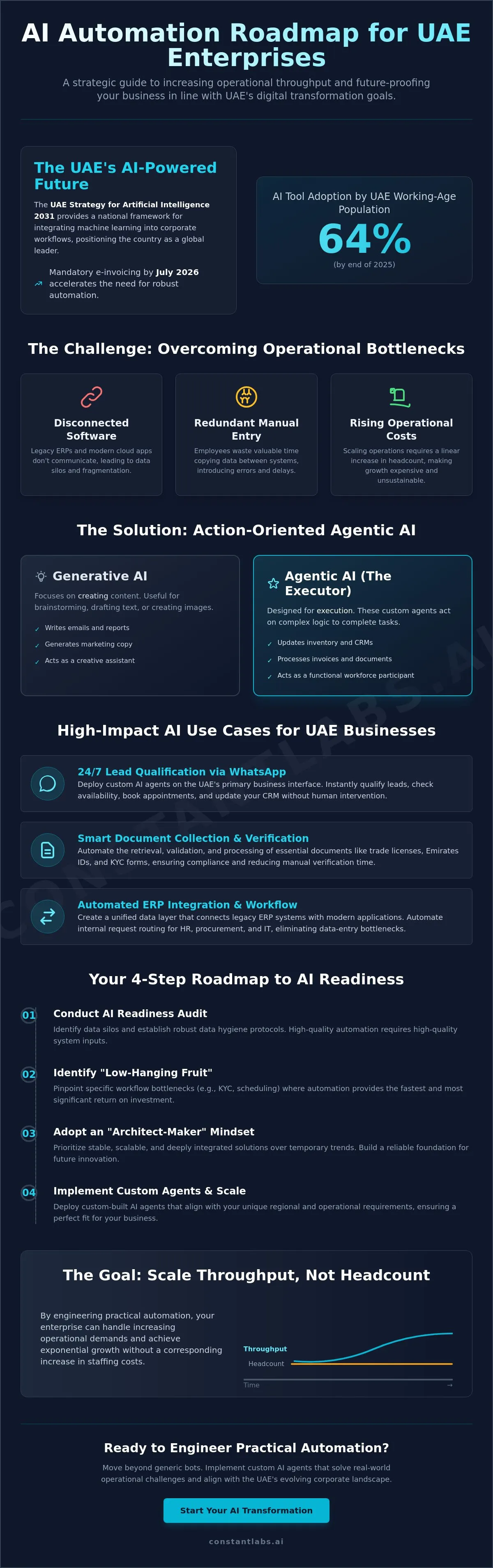
AI implementation for business automation is a systematic integration of machine learning and workflow logic into the core of an enterprise. It isn't about adding a standalone chatbot to a website. It's about building a cohesive layer that connects disparate software tools. This structural shift aligns with the UAE Strategy for Artificial Intelligence 2031, which aims to position the country as a global leader in AI adoption. The goal is to move beyond experimental pilots into permanent, mission-critical infrastructure that handles real-world operations with precision.
One critical distinction to understand is the difference between Generative AI and Agentic AI. While Generative AI focuses on content creation like text or images, Agentic AI is designed for execution. These agents don't just talk; they act. They can update inventory, process invoices, and route customer inquiries based on complex logic. For companies exploring AI use cases for business automation Dubai, this shift toward action-oriented systems represents the next phase of digital maturity. It transforms AI from a creative assistant into a functional workforce participant.
Why UAE Businesses are Prioritizing Custom Automation Now
Operational overhead is rising in the UAE's high-growth economy. Manual data entry and repetitive tasks are becoming expensive bottlenecks that slow down growth. As a global hub for trade and logistics, Dubai requires 24/7 responsiveness that human teams cannot always sustain. Many organizations are finding that their legacy ERP systems are too rigid for modern demands. By implementing a unified, AI-driven data layer, businesses can bridge the gap between old records and new, automated workflows. This transition is essential for those looking to scale without a linear increase in headcount.
Utility Over Hype: Defining Practical AI Use Cases
Successful automation requires an "Architect-Maker" mindset. This approach prioritizes stability and long-term scalability over flashy, temporary trends. Instead of simple LLM wrappers, we focus on functional business logic that integrates deeply with your existing stack. The most effective AI use cases for business automation Dubai often begin by identifying "low-hanging fruit." These are the specific workflow bottlenecks, like manual KYC verification or complex scheduling, where business process automation provides the fastest return on investment. By focusing on utility, enterprises can build a reliable foundation that supports future innovation across the entire organization.
02
High-Impact AI Use Cases for Business Automation in Dubai and Beyond
Dubai's commercial environment moves at a pace that demands immediate precision. Implementing AI use cases for business automation Dubai isn't just about general efficiency; it's about building systems that align with the nation's long-term vision. The UAE Strategy for Artificial Intelligence 2031 provides the framework for this transformation. Enterprises are now moving beyond basic software toward integrated layers that handle lead qualification, smart document collection, and internal request routing for HR and procurement departments. These systems don't just store data; they actively manage it to reduce operational friction.
Customer-Facing Automation: Custom AI Agents and WhatsApp
In the UAE, WhatsApp is more than a messaging tool; it's a primary business interface. Custom AI agents designed for this platform can qualify leads in real time, filtering inquiries based on your specific criteria. These agents don't just provide canned responses. They can check availability, book appointments directly into your calendar, and update CRM records instantly. This ensures 24/7 responsiveness without increasing your customer service headcount. If your current engagement process feels fragmented, exploring custom AI agents can bridge those gaps and ensure no high-value lead is ignored.
Operational Efficiency: Workflow Automation and ERP Integration
Many UAE enterprises struggle with disconnected software tools that require manual data entry to stay synchronized. Modern workflow automation solves this by creating a unified data layer between legacy ERP systems and cloud applications. For example, smart document collection can automate the retrieval and verification of KYC and corporate documents. This is particularly vital for compliance in the UAE's evolving regulatory landscape. By automating data flow, businesses can eliminate human error in repetitive financial reporting and ensure that all departments have access to a single source of truth.
Physical-Digital Integration: IoT and Hardware Prototypes
A significant gap in many automation strategies is the failure to connect digital logic with physical assets. We focus on engineering systems that utilize IoT sensors and hardware prototypes to provide real-time operational control. Telemetry dashboards can monitor physical assets, such as warehouse equipment or fleet vehicles, and feed that data directly into your digital management systems. This allows for predictive routing in supply chains and proactive maintenance scheduling. By integrating embedded software with your broader business ecosystem, you create a systematic loop where physical events trigger automated digital workflows without manual intervention.
03
Evaluating Custom AI Solutions vs. Off-the-Shelf Software
Selecting the right technological foundation is a strategic decision that dictates the long-term agility of your enterprise. Many firms in the region fall into the 'SaaS Trap' by attempting to bend their unique operational workflows to fit the rigid templates of generic software. This is a common pitfall when exploring AI use cases for business automation Dubai, as local market nuances often exceed the capabilities of standard global tools. Custom solutions provide the necessary flexibility to integrate directly with regional logistics APIs, local payment gateways, and specific trade regulations that off-the-shelf products frequently overlook.
Data sovereignty is another critical factor that favors custom builds. Aligning your automation infrastructure with the UAE's Personal Data Protection Law (PDPL) requires precise control over data residency and processing protocols. Generic SaaS providers often host data on global clusters, which can complicate compliance for sensitive corporate information. By developing a proprietary system, you ensure that your data remains within your control, stored and routed according to local legal requirements. This security-first approach is essential for mission-critical automation that handles customer records or financial transactions.
The cost-benefit analysis of custom development centers on long-term scalability versus upfront investment. While the initial expenditure in AED for a custom build is higher than a monthly subscription, it eliminates the escalating per-user fees that characterize the SaaS model. As your team expands, a custom system allows you to scale your operational throughput without a linear increase in software costs. This makes custom development a more sustainable choice for high-growth enterprises looking to build a permanent digital asset rather than renting a temporary tool.
When to Buy: Using Off-the-Shelf Tools for Standard Functions
Buying is the logical choice for non-core processes that don't provide a competitive advantage. Standard functions like basic accounting, payroll processing, or general HR management are well-served by established SaaS products. Over-customizing these standard tools is a risk that often leads to technical debt and integration headaches. In these instances, it's more efficient to use middleware to connect existing SaaS tools to your broader ecosystem before considering a custom build. This allows you to focus your development resources on the areas that truly differentiate your business.
When to Build: The Case for Custom AI Agents and Software
Building is necessary when a process is central to your competitive edge. If your lead generation logic or logistics routing is unique to your business model, generic tools will only hold you back. Custom AI agents allow you to create proprietary IP that adds tangible value to your enterprise. From an 'Architect-Maker' perspective, building your own systems ensures they grow alongside your business. You can design the architecture to handle specific AI use cases for business automation Dubai, such as automated KYC verification or complex supply chain predictive routing, ensuring the system remains a stable and scalable asset for years to come.
04
Preparing Your UAE Business for AI Readiness
Transitioning from conceptual AI use cases for business automation Dubai to operational reality requires a disciplined preparation phase. Implementation without a structural foundation often leads to fragmented systems that fail to deliver a return on investment. To avoid these pitfalls, enterprises must adopt a methodical approach that prioritizes data integrity and infrastructure stability before deploying complex agents. This preparation ensures that your automation layer remains a reliable asset rather than a source of technical debt.
The readiness process follows five critical steps:
- Step 1: Conduct an AI Readiness Audit. This phase involves mapping existing data silos and identifying the specific bottlenecks where automation will provide the most immediate relief.
- Step 2: Establish a Data Hygiene Protocol. AI agents are only as effective as the information they process. You must ensure that your data inputs are clean, structured, and consistently updated.
- Step 3: Define Clear KPIs. Success should be measured through concrete metrics such as total hours saved, percentage of error reduction, or operational costs recovered in AED.
- Step 4: Upskill Internal Teams. Technology alone isn't enough. Providing professional AI training and strategy workshops ensures your staff can manage and optimize these new automated workflows.
- Step 5: Implement a Phased Rollout. Start with a high-impact, low-risk prototype to validate the logic before scaling the system across the entire organization.
The Role of the AI Readiness Audit
The AI readiness audit is a foundational technical diagnostic designed to evaluate an organization's current infrastructure and data maturity. During this process, we assess your technological stack for scalability and its capacity to integrate with custom agents. We also identify potential security vulnerabilities that could be exploited once systems are interconnected. This diagnostic ensures that your business doesn't just adopt technology for its own sake, but builds a resilient framework capable of supporting long-term growth. To begin this process for your organization, you can schedule a professional AI readiness audit to identify your most viable automation opportunities.
Compliance and Security in the UAE Context
Aligning your AI implementation with the UAE Federal Decree-Law on Personal Data Protection is a non-negotiable requirement for modern enterprises. As you automate data flows between internal systems and external AI models, you must establish secure, encrypted paths to protect sensitive corporate and customer information. This involves implementing rigorous operational controls that prioritize security, compliance, and reliability. By addressing these regulatory requirements during the readiness phase, you mitigate legal risks and build a system that is fully compliant with the UAE's evolving digital landscape.
05
The Constant Labs Approach: Engineering Practical Automation
We position ourselves as a technology studio that prioritizes process-driven engineering over temporary trends. Our "Architect-Maker" philosophy focuses on building the bridge between complex emerging technologies and tangible corporate utility. We don't just develop software; we engineer stable systems designed for long-term reliability. This disciplined approach is essential when identifying AI use cases for business automation Dubai, as it ensures that every automated layer serves a specific operational objective within the UAE's high-growth economy. We're committed to supporting national business growth through systematic digital transformation that prioritizes utility over flashiness.
Our capabilities extend across the entire technological spectrum. We build everything from custom web and mobile apps to complex physical hardware prototypes. By maintaining this breadth of expertise, we can address operational challenges that exist at the intersection of digital and physical environments. Whether you need a sophisticated workflow automation system or a custom AI agent, our goal is to create a cohesive ecosystem where all components work in unison to drive measurable efficiency.
From Prototype to Production: Our Development Lifecycle
Our development lifecycle moves methodically from initial concept to full-scale production. We begin by assessing the unique requirements of UAE enterprises to ensure that any custom software or AI agent aligns with local market conditions. A significant differentiator in our process is the integration of telemetry, IoT sensors, and robotics into unified dashboards. These interfaces allow you to monitor real-time data from physical assets alongside your digital workflows. We focus on long-term stability and deep system integration rather than deploying isolated tools that create new data silos. This ensures your infrastructure remains resilient as your operational demands scale.
Strategic Partnership for Long-Term Efficiency
We act as a strategic consultant for organizations looking to navigate the complexities of 2026's technological landscape. Our team provides comprehensive AI strategy consulting and develops digital transformation roadmaps tailored to your specific corporate goals. We don't believe in one-off installations. Instead, we offer ongoing support for all custom-built automation systems to ensure they continue to deliver a high return on investment. This partnership model allows your business to increase operational throughput without a linear increase in headcount. If you're ready to identify the most impactful automation opportunities for your organization, you can audit your business for AI readiness with Constant Labs.
06
Building a Resilient Automated Future in the UAE
The shift from experimental AI pilots to mission-critical infrastructure is a necessary evolution for enterprises seeking long-term stability. We've examined how the systematic integration of machine learning transforms corporate workflows from fragmented manual tasks into cohesive, action-oriented systems. Avoiding the common pitfalls of generic software is essential for maintaining data sovereignty and ensuring full alignment with local regulations like the PDPL. By focusing on high-impact AI use cases for business automation Dubai, your organization can achieve measurable gains in operational throughput while keeping overhead costs manageable.
Constant Labs operates as a specialized UAE-based technology studio with deep expertise in custom AI agent development and end-to-end hardware and software prototyping. We focus on the practical bridge between complex emerging technologies and their functional application in a corporate environment. Our team is dedicated to building the tools that drive your business forward with precision and reliability. Book an AI Readiness Audit for Your Business to begin mapping a clear path toward your automated future. The journey toward digital maturity is a steady process of engineering and refinement, and we are ready to build it with you.
03/constant labs cta
Turn one automation use case into a working system
04/answer engine faq
What are the most common AI use cases for businesses in the UAE?
The most frequent AI use cases for business automation Dubai include automated e-invoice processing to meet Federal Tax Authority requirements, smart KYC verification for customer onboarding, and predictive logistics for supply chain management. These systems focus on reducing manual overhead in high-growth sectors like trade, finance, and real estate. By integrating machine learning into these specific domains, companies can maintain compliance while increasing their operational throughput.
How much does it cost to implement AI automation for a mid-sized company?
The investment required for AI automation depends on the complexity of your existing software stack and the specific depth of system integration needed. Costs are determined by factors such as the volume of data being processed, the number of connected platforms, and the specialized logic required for your custom agents. A technical audit is the most effective way to define the necessary budget in AED based on your unique operational requirements.
Is a custom AI agent better than a standard chatbot for lead qualification?
A custom AI agent is significantly more effective than a standard chatbot because it focuses on execution rather than simple conversation. While chatbots typically follow rigid, scripted paths, custom agents integrate with your CRM to verify lead data, check real-time calendar availability, and book appointments. This ensures that your sales team receives high-quality, pre-qualified leads without the need for manual data entry or repetitive follow-up tasks.
How long does it take to build a custom workflow automation system?
Development timelines generally range from several weeks for a targeted prototype to several months for a comprehensive enterprise system. The exact duration is influenced by the quality of your existing data and the number of legacy systems that require integration. Adopting a phased rollout strategy allows your business to deploy high-impact automation modules quickly while the broader infrastructure is being finalized.
Does AI implementation require my business to replace its existing ERP?
You don't need to replace your current ERP to benefit from AI automation. Most advanced solutions are engineered as an intelligent layer that sits on top of your existing software, connecting disparate tools through secure system and ERP integrations. This allows you to modernize your business logic and automate complex workflows without the significant cost and operational disruption of a total platform replacement.
How do UAE data protection laws affect AI automation projects?
The UAE Federal Decree-Law on Personal Data Protection requires strict adherence to data sovereignty and secure processing protocols. Any AI automation project must ensure that personal data is handled through encrypted paths and stored according to regional legal requirements. Compliance isn't just a legal checkbox; it's a fundamental part of the technical architecture that protects your corporate interests and customer privacy.
Can AI agents integrate with WhatsApp for business communication?
Custom AI agents integrate directly with the WhatsApp Business API to facilitate seamless communication within the UAE's most utilized messaging platform. This integration allows your business to handle lead qualification, appointment scheduling, and customer inquiries 24/7. These agents don't just send messages; they route information directly into your internal databases to ensure your records stay updated in real time.
What is an AI readiness audit and why does my business need one?
An AI readiness audit is a foundational technical diagnostic that identifies data silos, security vulnerabilities, and infrastructure bottlenecks. Your business needs one to ensure that any AI use cases for business automation Dubai you pursue are built on a stable and scalable foundation. This audit prevents wasted investment by ensuring your data is clean and your systems are ready for deep integration before development begins.